Insights
Annual Insight Recap: Highlights from the Talkshow – The Future of Indonesia’s NPL Market
10 February 2026 5 minutes read
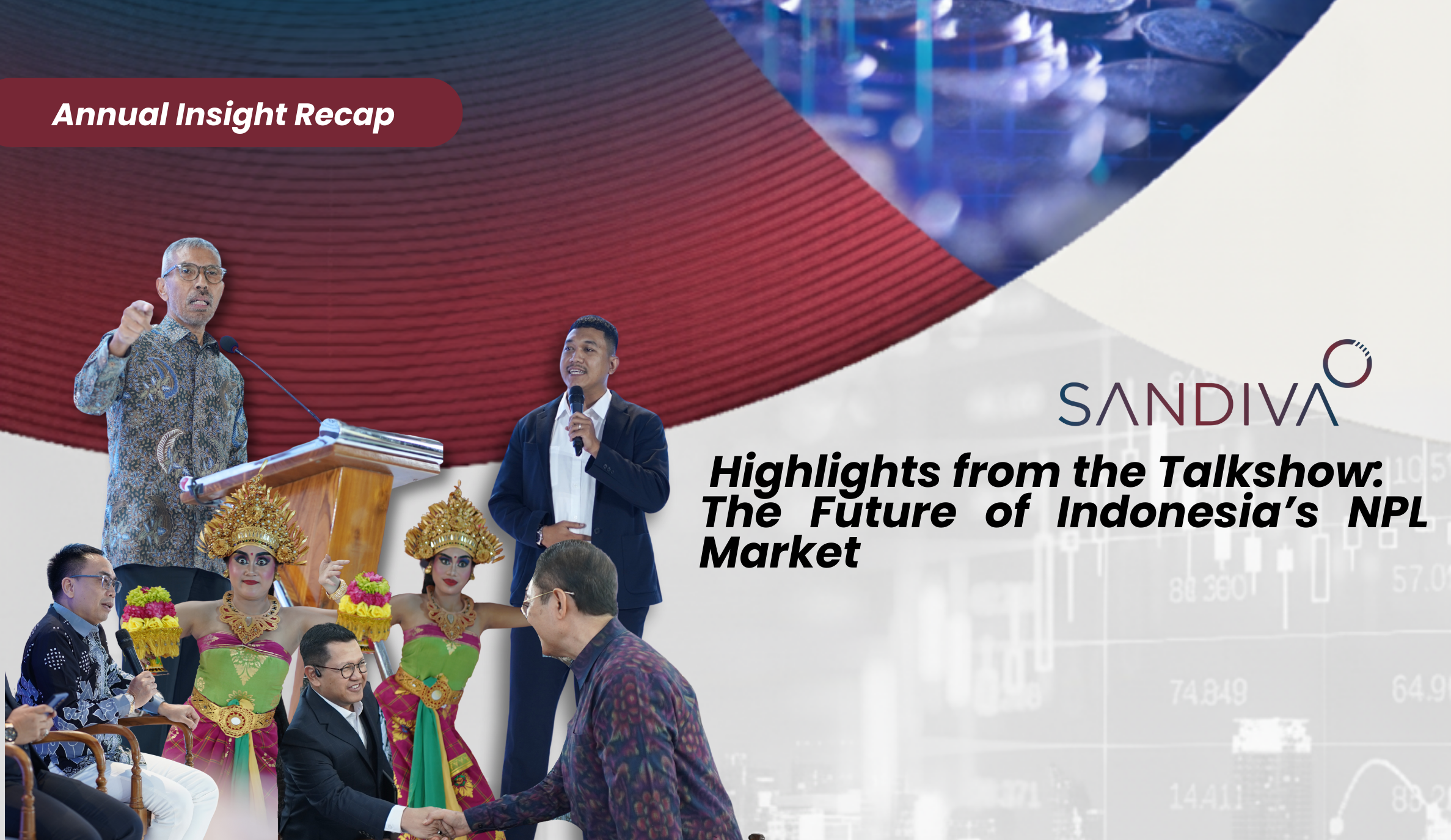
As part of the 2025 Annual Insight Recap series, Sandiva revisits key moments from the Talkshow & Networking Night on 9 October 2025, a forum that brought together representatives from financial institutions, regulators, banks, investors, and legal practitioners. The event, titled “Indonesia's NPL: Legal Frameworks and Strategic Market Outlook,” served as an essential platform to discuss the evolving landscape of Non-Performing Loans (NPLs), offering insights that remain highly relevant for assessing market direction in 2026.
Highlight From Keynote Speaker
The event opened with a performance of Tarian Sekar Jagat by the Ary Suta Center Dance Academy, followed by the opening remarks delivered by Mr. Robertus Billitea, S.H., M.H., Managing Director of Legal at BPI Danantara. In his keynote speech, he emphasized that although Indonesia’s NPL ratio appears manageable, the structural challenges in resolving NPLs remain significant, including weak legal frameworks, a stagnant secondary market, and rising barriers to asset execution.
He highlighted the need for reforms to bankruptcy and banking laws, the establishment of a stronger Asset Management Company (AMC) ecosystem, and the creation of a specialized court chamber for NPL cases to accelerate resolution. He also encouraged cross-industry collaboration to develop a national position paper as a foundation for improving Indonesia’s NPL ecosystem.
“When seminars like this are held, it means we all recognize that there are serious issues that must be addressed together,” he stated.
He further underscored the urgency of strengthening legal instruments, including by reforming the Commercial Court and enhancing the effectiveness of enforcement tools, to deliver greater legal certainty for the financial industry.
Current Snapshot of Indonesia’s NPL Market
Although Indonesia’s national NPL ratio remains relatively stable at 2–2.2%, panelists agreed that the country’s NPL market is still far from fully developed. Unlike countries such as South Korea and China, which already benefit from strong AMCs and active secondary markets, Indonesia continues to rely on traditional pathways such as restructurings and auctions, resulting in slower resolutions and limited investor engagement.
From the banking side, BNI highlighted that legal challenges remain a major obstacle. As Ms. Prihati shared, 79% of BNI’s disputes arise from auction-related issues, compounded by a steady rise in PKPU and bankruptcy filings. These trends show that execution barriers still heavily burden financial institutions.
Strengthening this perspective, Mr. Ahmad Fajar of ITDC emphasized that Indonesia urgently needs a more liquid and structured NPL ecosystem. He stressed the importance of developing a real secondary NPL market, backed by disciplined risk management and clearer mechanisms for NPL transfer. Without these improvements, banks will continue to face prolonged credit stress.
Regulators are also pushing for modernization. Dr. Diki Zaenal Abidin of KPKNL Tangerang II noted that 99% of auctions are now conducted electronically, significantly reducing room for manipulation. Ongoing regulatory enhancements, including the Draft Auction Law (RUU Perlelangan), aim to strengthen certainty further and streamline auction governance.
On the legal front, Sandiva’s Director Allova Herling Mengko reiterated why auctions remain one of the safest methods for resolving NPL-backed assets. Unlike notarial transactions, which may still face legal challenges, auction outcomes offer stronger legal certainty, making them a preferred option for investors dealing with complex asset situations.
From a market absorption standpoint, Ray White Indonesia’s Mr. Erwin Karya shared that distressed properties present considerable investment opportunities; however, investor education remains key. With a better understanding of valuation and legal safeguards, more investors are likely to enter the NPL market.
Bringing an international perspective, IFC’s Senior Investment Officer, Mr. Johannes Raschke, highlighted Indonesia’s strong appeal to global investors, while acknowledging that regulatory bottlenecks and lengthy enforcement processes continue to hold back institutional capital. He emphasized that improved regulatory clarity will be essential for unlocking Indonesia’s full potential.
The Road Ahead: Key Actions to Strengthen Indonesia’s NPL Ecosystem
The panelists concluded the session by outlining seven priority actions needed to accelerate the development of Indonesia’s NPL market:
- Establish more Asset Management Companies (AMCs) and build a transparent secondary market to enhance liquidity and accelerate NPL disposal.
- Strengthen bankruptcy and banking regulations, improve Commercial Court procedures, and develop more precise executorial mechanisms to support faster resolution.
- Advance digital auction infrastructure, finalize the Auction Law (RUU Perlelangan), and streamline joint auction mechanisms between banks and receivers.
- Promote regular investor forums, educational programs, and cross-industry outreach to expand understanding of NPL opportunities and reduce market hesitation.
- Encourage banks to reinforce risk appetite frameworks, early warning systems, and repayment capacity monitoring to prevent NPL formation.
- Promote more substantial alignment between banks, receivers, regulators, auction institutions, legal practitioners, and industry partners to streamline NPL processes.
- Improve access to valuation data, documentation standards, and market indicators to support better decision-making for investors and financial institutions.
Sandiva’s Perspective on Indonesia’s NPL Market in 2026
As Indonesia enters 2026, Sandiva sees the NPL market entering a pivotal stage, marked by growing investor appetite, greater regulatory clarity, and rising awareness of auctions as a secure and transparent asset-acquisition method. With these industry shifts, Sandiva remains committed to serving as a trusted legal and strategic partner in the NPL ecosystem.
Today, Sandiva manages a portfolio of NPL-backed assets that are ready for enforcement, supported by clear legal standing and compliant execution pathways. In parallel, Sandiva is also actively exploring opportunities to acquire NPL portfolios from banks, leveraging our experience in due diligence, restructuring, and enforcement to unlock value for both sellers and investors.
We believe that 2026 will be defined by stronger transparency, broader investor participation, and deeper cross-industry collaboration, three pillars that Sandiva will continue to champion across our ecosystem.
For financial institutions seeking strategic disposal options, investors looking to enter the NPL asset space, or partners exploring joint research and market collaboration, Sandiva welcomes engagement and dialogue.
To explore opportunities, please contact our team through the official channels on this website.
Contributor: Eunike Angelita - Business Relations Manager