Insights
Corporate Capital Structure: How Capital and Loans Rank Differently in Bankruptcy
18 November 2026 5 minutes read

This article provides general legal information as of 18 November 2026 and is not legal advice or a legal opinion on any specific case. For your situation, consult an advocate.
Choosing a corporate capital structure is not only about the cost of funds. Each funding source differs in control, tax and the funder's position if the company goes bankrupt or enters PKPU (Article 1 point 2, Article 55(1) and Article 281(1) of Law No. 37 of 2004).[2]
1. Share capital: shareholders, not creditors
Share capital strengthens equity and need not be repaid.
Control
A capital increase needs approval of the General Meeting of Shareholders (GMS); within the authorised capital, more than half of the votes must attend and approve (Articles 41(1) and 42(2) of Law No. 40 of 2007). New shares must first be offered to existing shareholders, diluting those who do not subscribe (Article 43(1)), and be fully paid (Article 33(3)).[1]
Tax
Dividends are not a deductible cost (Article 9(1)(a) of the Income Tax Law).[3]
Position under the Bankruptcy Law
A shareholder is not a creditor, as it holds no receivable claimable in court (Article 1 point 2 of Law No. 37 of 2004), so it lodges no claim and does not vote on the composition plan (Article 281(1)).[2] If the estate is insolvent, the receiver liquidates the company and shareholders get only what is left after all creditors (Article 142(1)(e) and (2)(a) and Article 149(1)(c) and (d) of Law No. 40 of 2007).[1]
2. Shareholder loans: unsecured creditors
Control
Funds come in without a GMS capital increase, unless the articles say otherwise, and ownership does not change.
Tax
Interest is in principle deductible (Article 6(1)(a) of the Income Tax Law),[3] subject to four limits:
· 4:1 DER cap: if exceeded, borrowing costs are limited (Articles 2(1) and 3(1) of MoF Regulation 169/PMK.010/2015).[4]
· Arm's length: related-party interest must be at arm's length (Article 18(3) of the Income Tax Law).[3]
· Withholding tax: Article 23 for domestic shareholders, Article 26 for foreign shareholders.[3]
· Reporting: unreported private offshore debt makes its borrowing costs non-deductible (Article 5 of MoF Regulation 169/PMK.010/2015).[4]
Position under the Bankruptcy Law
Without security, the loan is an unsecured claim that votes with other unsecured creditors in PKPU (Article 281(1)(a) of Law No. 37 of 2004).[2] Once converted into shares with GMS approval (Article 35 of Law No. 40 of 2007), the funder becomes a shareholder.[1]
3. Bank loans: secured creditors
Control
The shareholding stays the same, but bank covenants such as a leverage ratio, negative pledge, dividend ban and cross-default apply, and a breach can make the whole loan fall due early.
Tax
Interest can be a cost, but it counts toward the 4:1 DER on all of the company's debt.[4]
Position under the Bankruptcy Law
A secured bank may enforce its security as if there were no bankruptcy (Article 55(1) of Law No. 37 of 2004), subject to a stay of up to 90 days (Article 56(1)) or during PKPU (Article 246). It votes in its own class (Article 281(1)(b)) and, if it rejects the plan, is compensated at the lower of the collateral value or the actual loan value (Article 281(2)).[2]
4. At a glance
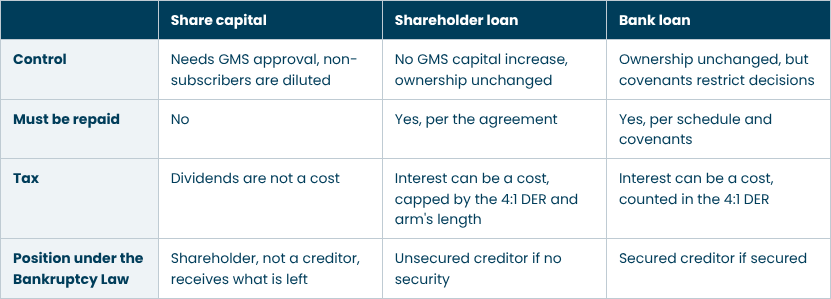
5. How capital structure plays out in a debt restructuring
In a debt restructuring Indonesia through PKPU, the plan needs approval from the unsecured and secured classes (Article 281(1) of Law No. 37 of 2004); if rejected, the court must declare the debtor bankrupt (Article 289).[2] Heavy secured bank debt gives secured creditors the deciding votes, while adequate equity is a buffer: with zero or negative equity, no borrowing costs are deductible (Article 3(5) of MoF Regulation 169/PMK.010/2015).[4]
Out-of-court debt reorganisation is covered by our Restructuring service. If negotiations fail and the company faces PKPU or bankruptcy, see how the process works on our Bankruptcy and Insolvency page.
Frequently asked questions
Can a shareholder loan be converted into shares?
Yes, with GMS approval under the rules for amending the articles, if the claim arises, for example, from money or assets the company received (Article 35 of Law No. 40 of 2007).[1]
Is interest on a shareholder loan always deductible?
No. Borrowing costs are capped by the 4:1 DER, interest must be at arm's length, and private offshore debt must be reported to the tax authority (Article 18(3) of the Income Tax Law and MoF Regulation 169/PMK.010/2015).[3][4]
If the company enters PKPU, does a shareholder who lent money get paid first?
No. Without security, it is an unsecured claim, while a secured bank keeps its collateral rights (Articles 55(1) and 281(1) of Law No. 37 of 2004). Share capital is not a creditor claim at all and is paid only from what is left.[1][2]
When to get advice
· New shareholder funds are coming, and their form is not yet decided.
· Debt-to-equity is nearing 4:1 or equity is turning negative.
· Offshore loans have not been reported.
· Bank covenants are hard to meet or a debt restructuring is being considered.
SANDIVA helps you map funding needs, test the legal and tax impact of each option, and build a corporate capital structure with room to move if debts need reorganising. Learn more about our Capital Structuring and Restructuring services, or discuss your funding structure with us via our Contact Us page or on WhatsApp at +62 857-5705-1234.
Sources
Bracketed numbers in the text refer to the list below. Accessed 19 November 2026.
[1] Law No. 40 of 2007 on Limited Liability Companies, as amended by Law No. 6 of 2023 on the Enactment of Government Regulation in Lieu of Law No. 2 of 2022 on Job Creation into Law, Article 33(3), Article 35, Article 41(1), Article 42(2), Article 43(1), Article 142(1)(e) and (2)(a), and Article 149(1)(c) and (d). JDIH BPK RI: Law 40/2007 and Law 6/2023.
[2] Law No. 37 of 2004 on Bankruptcy and Suspension of Debt Payment Obligations, Article 1 point 2, Articles 55(1), 56(1), 246, 281(1) and (2), and 289. JDIH BPK RI: Law 37/2004.
[3] Law No. 7 of 1983 on Income Tax, as amended several times, including by Law No. 36 of 2008 and Law No. 7 of 2021 on Harmonisation of Tax Regulations, Article 6(1)(a), Article 9(1)(a), Article 18(3), Article 23 and Article 26. JDIH BPK RI: Law 36/2008 and Law 7/2021.
[4] Minister of Finance Regulation No. 169/PMK.010/2015 on the Debt-to-Equity Ratio for Income Tax Purposes, Article 2(1), Article 3(1) and (5), and Article 5. JDIH Ministry of Finance: PMK 169/PMK.010/2015.