Insights
PKPU Administrator Fees: What Companies Should Know
23 November 2026 8 minutes read

This article provides general legal information as of 23 November 2026 and is not legal advice or a legal opinion on any specific case. For your situation, consult an advocate.
Under Article 234(5) of Law No. 37 of 2004 on Bankruptcy and Suspension of Debt Payment Obligations (the Bankruptcy and PKPU Law), the fee of a PKPU administrator (pengurus, the administrator in a suspension of debt payment obligations, or PKPU) is set by the court after the PKPU ends, based on a guideline issued by the Minister responsible for law and legislation, and must be paid first from the debtor's estate.[1] The guideline currently in force is Minister of Law Regulation No. 20 of 2025 on the Guideline for Fees of Receivers and Administrators, which revoked Minister of Law and Human Rights Regulation No. 18 of 2021.[2]
For directors, the fee of a PKPU administrator is more than an administrative cost item. If the administrator's fee is unpaid or unsecured, the court must refuse to approve the composition plan and, in the same decision, declare the company bankrupt.[3] This article explains the legal basis for setting the PKPU administrator's fee, who bears it, and practical steps to budget for it from the start of the PKPU.
The PKPU Administrator Manages the Estate Together with the Debtor
The Commercial Court appoints the administrator in the temporary PKPU order, together with the supervisory judge. If the debtor files the petition, the court must issue its decision no later than 3 days after registration; if a creditor files, no later than 20 days after registration (Article 225(2) and (3)). The court may appoint one or more administrators, who manage the debtor's assets jointly with the debtor.[4]
From the moment the temporary PKPU is ordered, the directors' powers are limited. Without the administrator's consent, the debtor cannot carry out acts of management or disposal over all or part of its assets (Article 240(1)). Besides supervising the management of assets, the administrator must announce the temporary PKPU order, receive and verify creditors' claims, prepare the list of claims, and submit a written report on the composition plan at the creditors' meeting (Articles 226(1), 270 to 272, and 278(1)). The whole PKPU process, including extensions, runs for a maximum of 270 days from the temporary PKPU order (Article 228(6)).[4]
The Law Sets the Requirements, the Liability and How the Fee Is Fixed
Article 234 of Law No. 37 of 2004 sets the same framework for every PKPU case:[1]
· Independent. The administrator must be independent and have no conflict of interest with either the debtor or the creditors (paragraph (1)). An administrator proven not to be independent faces criminal and/or civil sanctions under the applicable laws and regulations (paragraph (2)).
· Has special expertise and is registered. The administrator is an individual domiciled in the Republic of Indonesia, with special expertise in managing a debtor's assets, and registered with the ministry responsible for law and legislation (paragraph (3)).
· Liable. The administrator is liable for errors or negligence in carrying out the management duties that cause loss to the debtor's estate (paragraph (4)).
· Fee. The administrator's fee is set by the court on the basis of the Minister's guideline after the PKPU ends, and must be paid first from the debtor's estate (paragraph (5)).
Two strategic implications deserve directors' attention. First, the final fee is only formally set by the court after the PKPU ends, so throughout the process the company works on the basis of an agreement or an estimate. Second, because the fee must be paid first from the debtor's estate, it must be calculated up front, before the company decides how much it can pay creditors under the composition plan.
Minister of Law Regulation 20 of 2025 Is the Current Fee Guideline
The guideline mandated by Article 234(5) of the Bankruptcy and PKPU Law is now set out in Minister of Law Regulation No. 20 of 2025 on the Guideline for Fees of Receivers and Administrators. It was enacted on 21 May 2025, promulgated and in force from 27 May 2025 (State Gazette of the Republic of Indonesia 2025 No. 365), and revoked and replaced Regulation No. 18 of 2021.[2] Any PKPU cost projection that still relies on the 2021 regulation needs to be updated promptly.
Article 5 of Regulation No. 20 of 2025 sets the PKPU administrator's fee in two layers:[2]
· Primary mechanism (agreement): The administrator's fee is paid on the basis of an agreement between the debtor and the administrator, taking into account the creditors' views, and is then set by the panel of judges (Article 5(1) and (3)). The fee is borne by the debtor and is calculated from the value of the debt to be paid (Article 5(2)).
· If no agreement is reached: The panel of judges sets the fee subject to a maximum that depends on how the PKPU ends (Article 5(4)):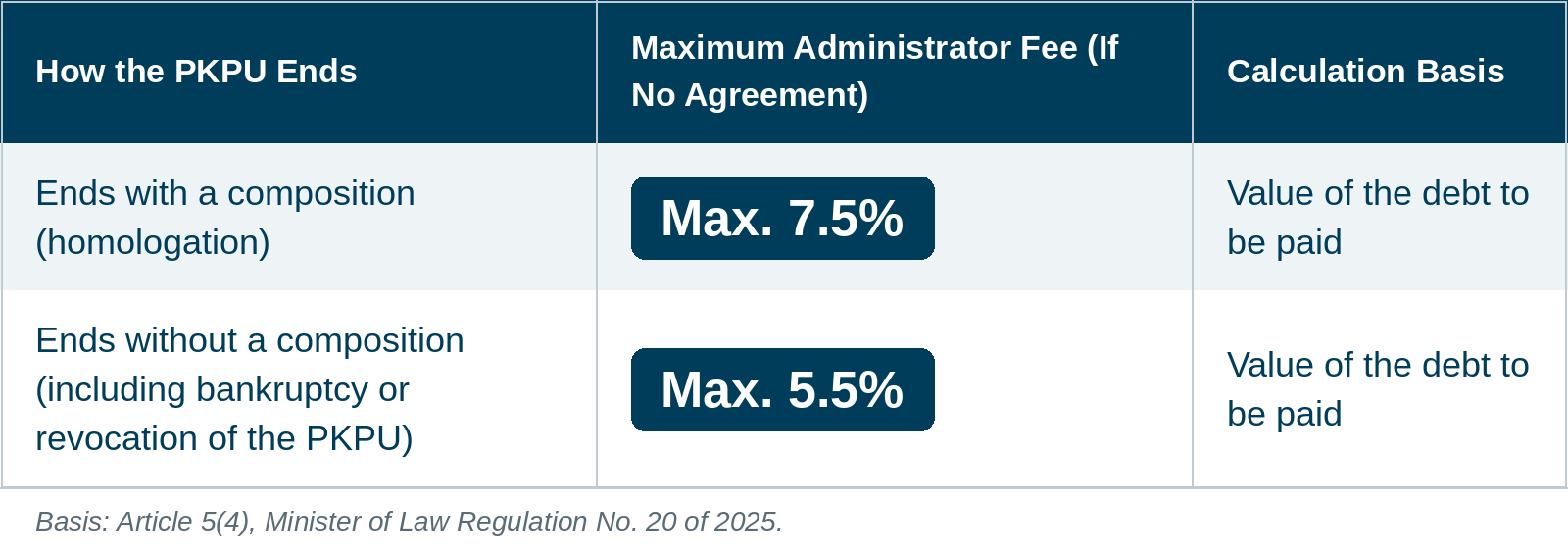
Note that Regulation No. 20 of 2025 does not define in detail the phrase "the value of the debt to be paid": whether it means the total of all verified debts in the final list of claims, or the effective obligations payable under the restructuring scheme in the composition plan. In addition, unlike receivers' fees, which follow a descending tiered scale with a maximum nominal cap in the Annex, administrators' fees have only a single percentage cap. Companies are therefore strongly advised to ask the administrator for a written explanation of the calculation basis, with a simulation, from the outset.
The Debtor Bears the Fee, Including in a Creditor-Filed PKPU
Both Article 234(5) of the Bankruptcy and PKPU Law and Article 5(2) of Regulation No. 20 of 2025 expressly place the administrator's fee on the debtor, without distinguishing whether the PKPU petition was filed by the debtor itself or by a creditor.[1][2]
If a creditor's PKPU petition is rejected by the court at the outset, no administrator is appointed and no administrator's fee arises. However, once a temporary PKPU is granted and an administrator is appointed, the company must still bear the PKPU administrator's fee from its own assets, even though the PKPU was not its own initiative. Unlike the rules on annulment of a bankruptcy order or rejection of a bankruptcy petition for a provisional receiver, Regulation No. 20 of 2025 does not shift the administrator's fee to the petitioning creditor.
An Unpaid Fee Can Derail Court Approval of the Composition
Once creditors approve the composition plan by vote, the court examines the application to ratify it (homologation). This is the critical point for directors: Article 285(2)(d) of the Bankruptcy and PKPU Law requires the court to refuse ratification if the fees and costs incurred by experts (if appointed under Article 238) and the administrator have not been paid or no security has been given for their payment.[3] If ratification is refused, the court must declare the debtor bankrupt in the same decision (Article 285(3)).[3]
In other words, even though the fee is formally set after the PKPU ends, a company cannot put off preparing payment until after the decision. A plan backed by a majority of creditors can still fail and end in bankruptcy solely because the PKPU administrator's and experts' fees were not paid or secured before the ratification hearing.
Five Steps to Budget for the PKPU Administrator's Fee
· Map all debts and the creditor profile before or right after the PKPU starts. An accurate debt list is the main basis for projecting PKPU costs and for estimating the calculation basis of the administrator's fee under Article 5 of Regulation No. 20 of 2025.[2]
· Discuss the fee estimate and process costs in writing from the outset. Ask for a breakdown of the estimated fee and its calculation basis, including the operating costs of the PKPU process such as announcements in the State Gazette and at least two daily newspapers (Article 226(1)), for which the administrator may ask the debtor for an advance (Article 269(4)).[4]
· Set aside a reserve or a dedicated security instrument. Article 285(2)(d) of the Bankruptcy and PKPU Law leaves only two options before ratification: the administrator's (and any expert's) fees and costs have been paid in full, or their payment has been secured.[3] Keep this allocation separate from the company's day-to-day operating cash.
· Write the fee explicitly into the composition plan. Set out the source of funds, the security mechanism and the payment schedule for the PKPU administrator's fee (and for any expert appointed by the supervisory judge under Article 238, whose fee is set under Article 263) in the composition plan and the cash-flow forecast.[3]
· Prepare the composition plan early to keep the PKPU's duration under control. The 270-day period is a maximum, not a target.[4] The sooner the plan is ready and agreed, the better controlled the operating costs and negotiation burden during the PKPU.
Frequently asked questions
Can a company negotiate the PKPU administrator's fee?
Yes. Article 5(1) of Regulation No. 20 of 2025 makes an agreement between the debtor and the administrator the primary basis for paying the fee, while still taking the creditors' views into account (paragraph (3)).[2] The 7.5% or 5.5% cap becomes the reference only if no agreement is reached (paragraph (4)). Even so, under Article 234(5) of the Bankruptcy and PKPU Law and Article 5(1) of Regulation No. 20 of 2025, the final amount is still set by the panel of judges.[1][2]
When must the PKPU administrator's fee be paid?
In principle, the administrator's fee is set by the court after the PKPU ends and paid first from the debtor's estate (Article 234(5) of the Bankruptcy and PKPU Law).[1] In practice, however, where the PKPU is heading to a composition, payment or security must be completed before the ratification hearing, because failing to meet this requirement obliges the court to refuse homologation and declare the debtor bankrupt (Article 285(2)(d) and (3)).[3]
Is the administrator still paid if the PKPU ends in bankruptcy?
Yes. Article 234(5) of the Bankruptcy and PKPU Law does not make the administrator's entitlement to a fee conditional on a successful composition; the fee is still set by the court and must be paid first from the debtor's estate.[1] If there is no agreement, Article 5(4)(b) of Regulation No. 20 of 2025 caps the fee at 5.5% of the value of the debt to be paid for a PKPU that ends without a composition.[2] Furthermore, if the debtor is declared bankrupt, debts of the debtor's estate arising during the PKPU become debts of the bankruptcy estate (Article 262(1)(b) of the Bankruptcy and PKPU Law), so they are settled first from the bankruptcy estate.[5]
When to get advice
· Your company is considering filing for PKPU itself and needs to estimate the full cost of the process.
· A creditor has filed for PKPU against your company and you do not yet know the likely administrator's fee.
· A composition plan has been drafted, but there is no source of funds or security for the administrator's fee.
· You have doubts about the administrator's independence or the fee calculation proposed.
Sandiva supports directors in preparing for and going through a PKPU, including mapping process costs and administrator fees from the outset and handling the Commercial Court proceedings. Learn more about our Bankruptcy and Insolvency and Insolvency and Bankruptcy services, or discuss your PKPU plans with us via our Contact Us page or on WhatsApp at +62 857-5705-1234.
Sources
Bracketed numbers in the text refer to the list below. Accessed 5 November 2026.
[1] Law No. 37 of 2004 on Bankruptcy and Suspension of Debt Payment Obligations, Article 234(1) to (5). JDIH BPK RI: Law 37/2004.
[2] Minister of Law Regulation (Permenkum) No. 20 of 2025 on the Guideline for Fees of Receivers and Administrators, enacted 21 May 2025, promulgated and in force 27 May 2025, State Gazette 2025 No. 365, revoking Minister of Law and Human Rights Regulation No. 18 of 2021. JDIH BPK RI: Minister of Law Regulation 20/2025.
[3] Law No. 37 of 2004, Article 238(1), Article 263, and Article 285(2)(d) and (3). JDIH BPK RI: Law 37/2004.
[4] Law No. 37 of 2004, Articles 225(2) and (3), 226(1), 228(6), 240(1), 269(4), 270 to 272, and 278(1). JDIH BPK RI: Law 37/2004.
[5] Law No. 37 of 2004, Article 262(1)(b). JDIH BPK RI: Law 37/2004