Insights
Receiver vs. Liquidator
27 April 2026 5 minutes read

Executive Summary
When a company in Indonesia faces financial distress or dissolution, two distinct legal processes may come into play: bankruptcy (kepailitan) and liquidation (likuidasi). While both processes involve settling a company's obligations and assets, they operate under different legal frameworks, with different officials — a Receiver (Kurator) and a Liquidator (Likuidator) — taking charge respectively. Understanding the distinction is critical for any board member, executive, or investor navigating corporate restructuring or exit scenarios in Indonesia.
The Legal Framework at a Glance
Indonesian law provides two primary routes for winding down a company:
- Bankruptcy proceedings governed by Law No. 37 of 2004 on Bankruptcy and Suspension of Payment Obligations (UU 37/2004)
- Corporate dissolution governed by Law No. 40 of 2007 on Limited Liability Companies (UU 40/2007)
Each route appoints a different officer and operates under a different authority structure.
The Receiver: Managing Bankruptcy Estates
Who is a Receiver?
A Receiver is a court-appointed official designated by the Commercial Court (Pengadilan Niaga) once a bankruptcy declaration has been issued. From the moment the bankruptcy ruling is pronounced, the debtor company loses all legal capacity to manage its own assets. That authority transfers entirely to the Receiver, who operates under the supervision of a Supervisory Judge (Hakim Pengawas).
Core Responsibilities
- Announcing the bankruptcy declaration to creditors and the public
- Convening creditor meetings to verify and rank claims
- Managing, securing, and inventorying the bankruptcy estate (boedel pailit)
- In the insolvency phase: liquidating the estate to pay creditors in order of priority
In practice, the Receiver's liquidation of the bankruptcy estate effectively ends the company's legal existence, making the Receiver function similarly to a liquidator in outcome, but within a court-supervised, creditor-first framework.
Accountability
Under Article 72 of UU 37/2004, a Receiver bears personal liability for losses caused by negligence or errors in performing their duties. Accountability runs directly to the Commercial Court.
The Liquidator: Managing Voluntary Dissolution
Who is a Liquidator?
A Liquidator is appointed to oversee the winding-down of a company that has been dissolved — but not necessarily through bankruptcy. Dissolution can occur through a General Meeting of Shareholders (RUPS) resolution, the expiry of the company's charter period, or a court order.
Core Responsibilities
- Inventorying and securing company assets
- Collecting receivables and settling liabilities to creditors
- Selling company assets if needed to fulfil obligations
- Distributing residual assets to shareholders after all debts are settled
- Filing administrative notifications, including public announcements of dissolution and liquidation
- Preparing and submitting a liquidation completion report
Unlike the Receiver, the Liquidator's process is not exclusively creditor-focused. After obligations to creditors are met, remaining assets are distributed to shareholders — a fundamental procedural difference.
Accountability
The Liquidator is accountable to the RUPS or to the court that appointed them (Article 152, UU 40/2007). Their report must account for all actions taken during the liquidation process.
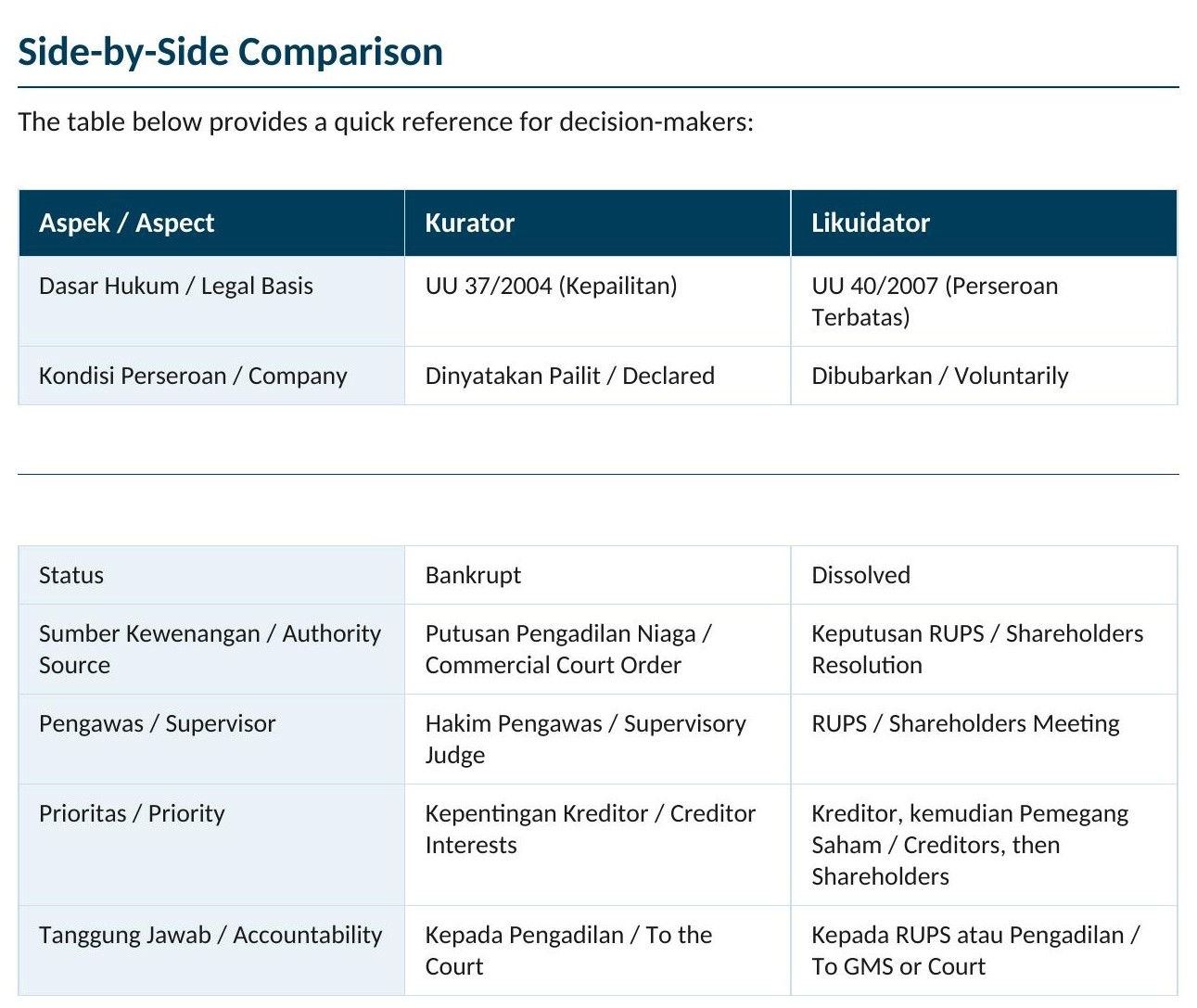
If a company is declared bankrupt by the Commercial Court → a Receiver takes charge. The process is court-driven and creditor-first. If a company is voluntarily dissolved by shareholders or by court order (non-bankruptcy) → a Liquidator is appointed. The process is company-driven, settling creditor claims before returning value to shareholders.
For boards and investors, the practical implication is significant: in bankruptcy, shareholders have virtually no residual rights. In liquidation, shareholders may still recover value. Choosing the correct legal pathway — or understanding which pathway applies — has direct consequences for asset recovery, liability exposure, and timeline.
Legal Basis Summary
- UU 37/2004, Article 1(5) — Definition of Receiver
- UU 37/2004, Article 24(1) — Loss of debtor's management rights upon bankruptcy
- UU 37/2004, Article 15(4), Article 82 — Creditor meetings
- UU 37/2004, Article 72 — Receiver's personal liability
- UU 40/2007, Article 142(1) — Grounds for corporate dissolution
- UU 40/2007, Article 152 — Liquidator's duties and accountability
Need help choosing the right pathway? If you are facing potential bankruptcy, restructuring, or a planned dissolution in Indonesia, our team can help you assess whether the situation falls under UU 37/2004 (Receiver/Kurator) or UU 40/2007 (Liquidator/Likuidator), and map the key steps, risks, and timeline.
Contact us: at https://wa.me/+6285757051234