Insights
Recovering Corporate Debt in Indonesia: PKPU or an Ordinary Lawsuit?
16 November 2026 9 minutes read

This article provides general legal information as of 16 November 2026 and is not legal advice or a legal opinion on any specific case. For your situation, consult an advocate.
To recover corporate debt, a creditor can take one of two legal routes: a breach-of-contract claim at the district court or a petition for suspension of debt payment obligations (PKPU) at the Commercial Court. PKPU is only available where the debtor has more than one creditor and at least one debt is due and payable (Article 222(3) in conjunction with Articles 2(1) and 8(4) of Law No. 37 of 2004, as applied in Commercial Court practice).[1] On this route, your receivable is lodged as a PKPU creditor claim.
In a PKPU, a creditor does not collect on its own. The creditor lodges its claim with the court-appointed administrator and then uses its voting rights on the composition plan together with the other creditors.[2]
Our earlier article (Unpaid Invoices for Months: Demand Letter, Lawsuit or PKPU?) covered a demand letter, a lawsuit and PKPU as three recovery routes. This article focuses on the one decision that comes after a demand letter fails: sue on your own, or collect collectively through PKPU.
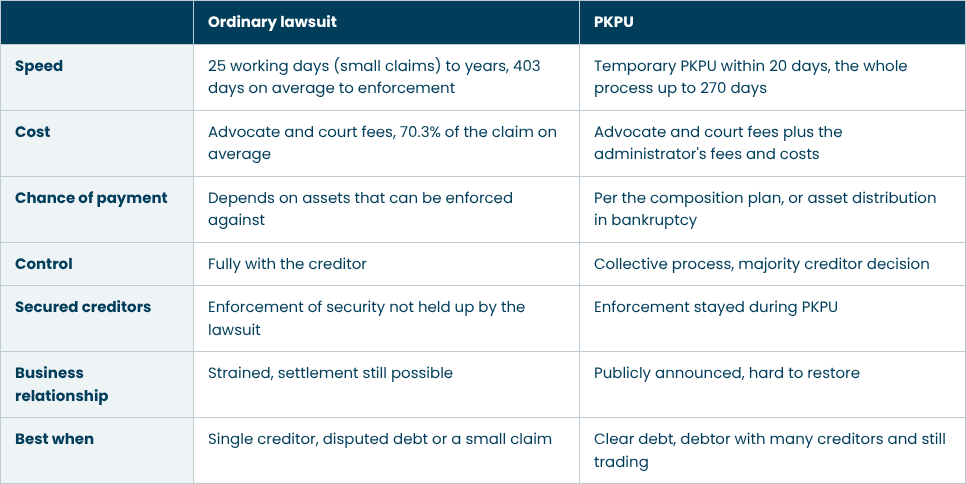
Which Route Is Faster?
PKPU is subject to strict statutory deadlines. On a creditor's petition, the Commercial Court must grant a temporary PKPU no later than 20 days after the petition is registered (Article 225(3)). The next hearing is held no later than the 45th day after the temporary PKPU order is pronounced (Article 225(4)), and the entire PKPU period, including extensions (permanent PKPU), may not exceed 270 days (Article 228(6)).[2]
An ordinary lawsuit is not bound by deadlines that strict. Claims up to IDR 500 million can use the small-claims procedure, which must be decided within 25 working days of the first hearing, provided both parties are domiciled within the same court's jurisdiction (or the claimant appoints a lawyer based in the defendant's jurisdiction) and attend the hearings in person.[3]
Otherwise, an ordinary lawsuit can take years, especially if there is an appeal and a cassation. The World Bank's Doing Business 2020 report found that resolving a contract dispute through Indonesian courts, from filing the claim to enforcing the judgment, takes 403 days on average, measured in Jakarta and Surabaya.[4]
Which Route Costs Less?
Both routes require advocate fees and court fee deposits, but the cost structure differs. A PKPU involves the administrator's fee, which the court sets after the PKPU ends and which must be paid first out of the debtor's assets (Article 234(5)). The court must also refuse to ratify a composition (homologation) if the administrator's fees and costs have not been paid or secured (Article 285(2)(d)).[2]
Who bears the administrator's fee is governed by Minister of Law Regulation No. 20 of 2025 on Guidelines for the Fees of Receivers and Administrators. The fee is charged to the debtor (Article 5(2)). If a PKPU filed by a creditor ends without a composition, the panel of judges sets the administrator's fee at no more than 5.5% of the debt to be paid (Article 5(4)(b)).[5]
An ordinary lawsuit has no administrator's fee, but costs through enforcement can escalate. Doing Business 2020 puts the average cost of a contract dispute in Indonesia at 70.3% of the claim. The Doing Business series was discontinued in 2021, but the figure can still serve as an indication.[4]
Which Route Is More Likely to Produce Payment?
A lawsuit produces a judgment for the claimant creditor alone. If the debtor does not pay voluntarily, the judgment still has to be enforced, and the result depends on the debtor assets that can be found.[4] The risk is that a lawsuit's results can be held up if the debtor later enters PKPU. During PKPU, all enforcement actions already started are suspended, and attachments lapse once the permanent PKPU or the ratification of the composition becomes final, unless the court sets an earlier date (Article 242(1) and (2)).[2]
PKPU aims at a collective settlement. If the composition plan is ratified (homologation), payment follows the plan, for example in instalments or as a partial payment of the debt (haircut). The composition binds all creditors except secured creditors who rejected the plan (Article 286 in conjunction with Article 281(2)). Existing debts may only be paid to all creditors in proportion to their claims (Article 245). If the plan is rejected in the vote, the court must declare the debtor bankrupt (Article 289).[2] Doing Business 2020 puts the average recovery rate in insolvency in Indonesia at 65.5 cents on the dollar over about 1.1 years.[4]
Who Is in Control?
In an ordinary lawsuit, the creditor is in control: when to sue, how much to claim and when to settle. In a PKPU, control moves to a collective process. The supervisory judge sets the timetable, the administrator manages the debtor's assets together with the debtor (Article 240(1)), and the fate of the composition plan is decided by a majority vote of unsecured and secured creditors (Article 281(1)). Your vote is only part of a collective decision.[2]
Where Do Secured Creditors Stand?
PKPU does not apply to claims secured by security rights over assets, such as a pledge, fiduciary security, mortgage over land or ship mortgage (Article 244(a)). However, secured creditors' enforcement rights are still stayed while the PKPU lasts (stay period) under Article 246. Secured creditors vote in their own class, and a secured creditor that rejects the plan is entitled to compensation equal to the lower of the value of the collateral or the actual value of the loan it secures (Article 281(2)).[2]
Unsecured creditors have no such protection. For them, the collective pressure of PKPU is often worth more than a lawsuit judgment that is hard to enforce.
What Does Each Route Do to the Business Relationship?
PKPU is public. The administrator must announce the temporary PKPU order in the State Gazette of the Republic of Indonesia and in at least two daily newspapers (Article 226(1)).[2] The announcement signals to the market that the debtor is in financial distress, so business trust is hard to restore.
An ordinary lawsuit carries no such announcement duty. Although it can still strain the relationship, it is a more private route and still leaves room for a negotiated settlement between the two parties.
What Does the End Result of Each Route Look Like?
· Lawsuit: a judgment ordering the debtor to pay. Payment comes voluntarily or through enforcement against the debtor's assets, and all proceeds go to you.
· Successful PKPU: a court-ratified composition with a payment schedule for all creditors. The debtor keeps operating and pays from its business.
· Failed PKPU: the debtor is declared bankrupt, its assets are sold by the receiver and the proceeds are distributed in the order of priority set by law.[2]
When Should the Two Routes Be Combined?
The two routes do not exclude each other. PKPU does not stop pending cases or prevent new ones (Article 243(1)). However, during PKPU the debtor can only be a claimant or defendant on matters concerning its assets with the administrator's approval (Article 243(3)).[2]
Combining the two routes makes sense in three situations:
· The debt is still disputed: Sue first to establish the debt. If the debtor still does not pay and is also behind with other creditors, a PKPU petition can follow.
· A lawsuit is under way when the debtor enters PKPU on someone else's petition: Lodge your PKPU creditor claim with the administrator promptly so that it is counted and you can take part in the vote and the distribution.
· The debtor has clear assets but many creditors are pursuing it: Waiting for a judgment risks leaving you behind the collective PKPU process.
Frequently asked questions
Can I still sue if the debtor is already in PKPU?
Yes, with limits. PKPU does not prevent new cases (Article 243(1)), but during PKPU the debtor cannot be compelled to pay its debts and enforcement is suspended (Article 242(1)). To take part in the vote and receive payment under the composition plan, you still need to lodge your PKPU creditor claim with the administrator.[2]
How do I lodge a PKPU creditor claim when someone else filed the PKPU?
Lodge it before the deadline set by the supervisory judge (Article 268(1)). Submit a written claim or other written evidence to the administrator stating the nature and amount of the claim with supporting evidence, and ask for a receipt (Article 270). The administrator then records in the list of claims whether the claim is admitted or disputed, for the claims verification meeting (Article 272).[2]
Can a debt disputed by the debtor be collected through PKPU?
Generally not. A PKPU petition is only granted if the existence of the debt is proven simply (Article 8(4)). A reasoned dispute by the debtor often means this condition is not met, so the petition risks being rejected. For a disputed debt, an ordinary lawsuit or the small-claims procedure is the better way to establish the debt first.[1][3]
When to get advice
· Your demand letter went unanswered and you need to choose between a lawsuit and PKPU.
· You hear the debtor is also behind with other suppliers or banks.
· You have already sued, and the debtor has entered PKPU on someone else's petition.
· You hold security and want to know how PKPU affects your enforcement rights.
Sandiva helps creditors weigh a lawsuit against PKPU based on the claim value, the strength of the evidence and the debtor's condition, including when the debtor owes many creditors. Learn more about our Debt Recovery Planning and Bankruptcy and Insolvency services (including PKPU), or discuss your claim with us via our Contact Us page or on WhatsApp at +62 857-5705-1234.
Sources
Bracketed numbers in the text refer to the list below. Accessed 5 November 2026.
[1] Law No. 37 of 2004 on Bankruptcy and Suspension of Debt Payment Obligations, Articles 2(1), 8(4), and 222(1) and (3). JDIH BPK RI: Law 37/2004.
[2] Law No. 37 of 2004, Articles 225(3) and (4), 226(1), 228(6), 234(5), 240(1), 242(1) and (2), 243(1) and (3), 244, 245, 246, 268(1), 270, 272, 281, 285(2), 286 and 289. JDIH BPK RI: Law 37/2004.
[3] Supreme Court Regulation (Perma) No. 2 of 2015 on the Small Claims Procedure, as amended by Perma No. 4 of 2019, Article 1 points 1 and 4, Article 3(1), Article 4(3a) and (4), and Article 5(3). JDIH BPK RI: Perma 2/2015 and Perma 4/2019.
[4] World Bank, Doing Business 2020: Economy Profile of Indonesia, published 24 October 2019. Enforcing Contracts: 403 days for the whole contract dispute, from filing the claim to enforcing the judgment, at a cost of 70.3% of the claim, measured in Jakarta and Surabaya. Resolving Insolvency: 65.5 cents on the dollar, 1.1 years. The Doing Business series was discontinued in 2021. IDN.pdf.
[5] Minister of Law Regulation (Permenkum) No. 20 of 2025 on Guidelines for the Fees of Receivers and Administrators, Article 5(2) and (4)(b). JDIH BPK RI: Permenkum 20/2025.