Temporary vs Permanent PKPU: Timelines and Legal Effects
10 November 2026 7 minutes read
This article provides general legal information as of 11 November and is not legal advice or a legal opinion on any specific case. For your situation, consult an advocate.
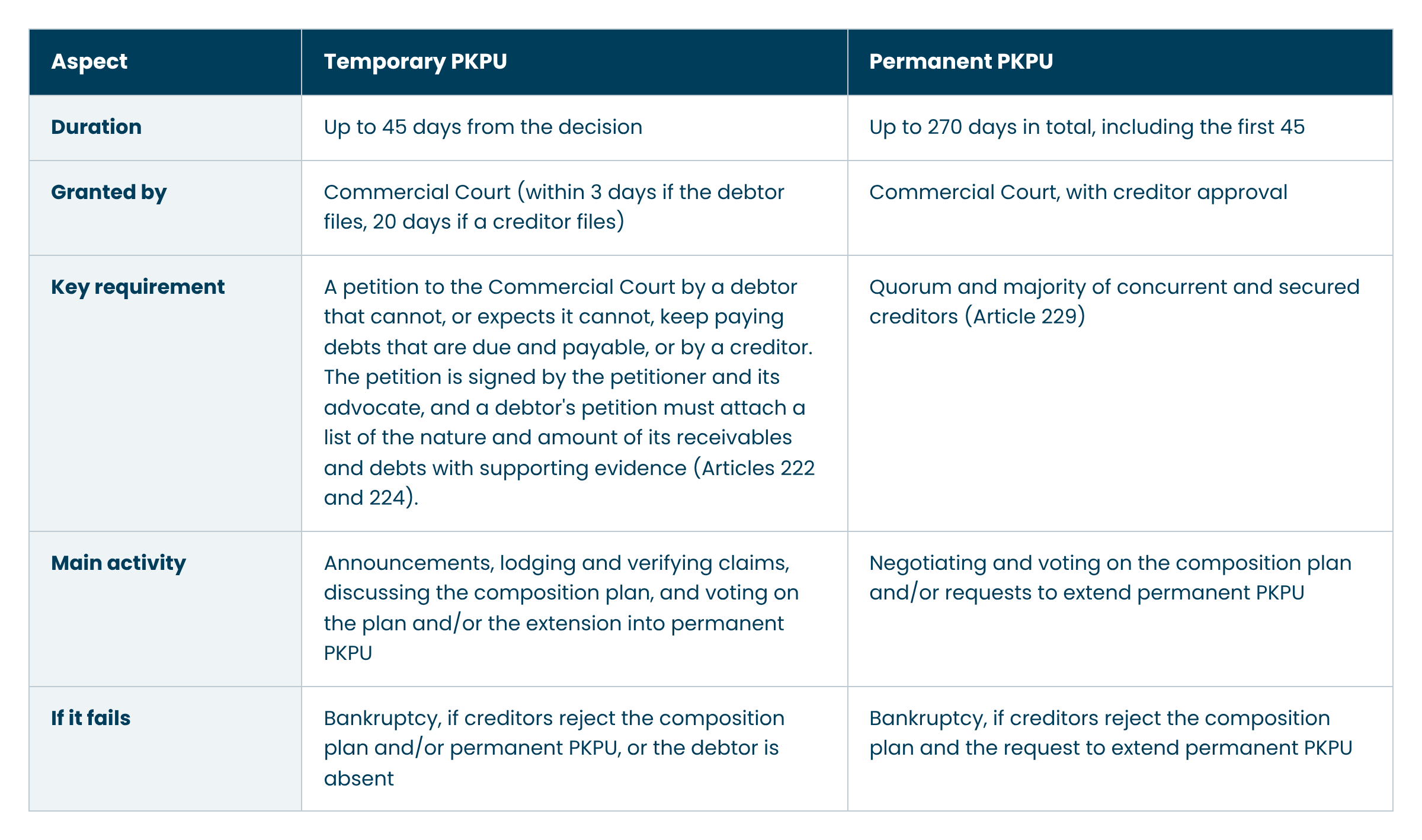
PKPU (suspension of debt payment obligations) runs in two connected stages. Temporary PKPU lasts up to 45 days from the court's decision. If creditors agree, it becomes permanent PKPU, capped at 270 days in total, including the first 45. If no composition plan is approved by then, the court must declare the debtor bankrupt.[1][2]
This article explains what happens at each stage, the legal effects for the company and the risks directors should watch.
Why is PKPU split into two stages?
The split lets the court and creditors test how serious the debtor is. The temporary stage is fast and protective: it suspends payment obligations so the debtor has time to formulate a composition proposal. Permanent PKPU is granted if all creditors by acclamation, or a majority of creditors, agree to give the debtor time to prepare the best possible proposal. Both stages form one continuous process, not two separate petitions.[2]
Stage 1: Temporary PKPU (up to 45 days)
When it starts
If the debtor files, the Commercial Court must grant temporary PKPU within 3 days of registration. If a creditor files, the court decides within 20 days (Article 225(2) and (3)).[1][2] In the same decision the court appoints a supervisory judge and one or more PKPU administrators.
What happens during the 45 days
• The administrator announces the PKPU and the creditors' meeting schedule in the State Gazette and in at least two daily newspapers, usually one national and one local newspaper (Article 226).[2]
• Creditors lodge their claims with the administrator, and the claims are then verified at a claims verification meeting.[2] Where needed, the administrator may hold a pre-verification before that meeting, an initial check of the claims and supporting documents with the creditors and the debtor, so that differences in claim amounts can be settled early.
• The debtor prepares and drafts a PKPU composition plan to put to the creditors.
• By day 45 at the latest, the court holds a hearing (Rapat Permusyawaratan Hakim) to hear statements from the debtor, a report from the administrator, a recommendation from the supervisory judge, and statements from the creditors (Article 225(4)).[2][4]
How the temporary stage ends
There are three possible outcomes:
1. The creditors approve the composition plan straight away, and the plan is submitted for court ratification (homologation).
2. The creditors grant permanent PKPU to give the debtor more time to refine its composition plan.
3. The creditors refuse permanent PKPU, and the debtor is declared bankrupt.[3]
In addition, if the debtor does not attend the hearing, temporary PKPU ends and the court must declare the debtor bankrupt at the same hearing (Article 225(5)).[4]
Stage 2: Permanent PKPU (270 days in total)
Creditor approval
Permanent PKPU is granted only with the approval of (Article 229(1)):[4]
• more than half of the concurrent (unsecured) creditors present, representing at least two thirds of the concurrent claims present, and
• more than half of the secured creditors present (pledge, fiduciary security, mortgage, hypothec or other collateral), representing at least two thirds of that group's claims present.
The 270-day cap
The court may extend permanent PKPU, but the whole PKPU timeline, including temporary PKPU and every extension, may not exceed 270 days from the temporary PKPU decision (Article 228(6)).[2] In practice, extensions are usually granted in steps, for example 30 or 60 days, as the creditors agree.[4]
If time runs out without a deal
The debtor is declared bankrupt if, at the creditors' meeting, the composition plan and/or the request to extend permanent PKPU is rejected, or if the 270-day limit is reached without an approved plan. The administrator reports the vote to the supervisory judge, who passes it to the deciding panel of judges, and the panel declares the debtor bankrupt in the Rapat Permusyawaratan Hakim (Article 230(1)).[3]
The following legal effects apply from the moment the temporary PKPU decision is pronounced:[5]
• Managing assets. The directors keep running the business, but acts of management or transfer of company assets require the PKPU administrator's approval (Article 240(1)).[5]
• Paying debts. The debtor cannot be forced to pay its debts. Payments of existing debts must be made to all creditors proportionally, not to selected creditors.[5]
• Attachments and enforcement. Existing attachments lapse by law, and enforcement against the debtor's assets is suspended, including secured creditors' enforcement rights while PKPU is in progress (Articles 242 and 246).[5]
• Court cases. PKPU does not stop pending cases, but the debtor cannot sue or be sued over its assets without the administrator's consent (Article 243).[6]
• Protection from bankruptcy. No bankruptcy petition can be filed against the debtor while PKPU is in progress.[5]
Risks for directors at each stage
For directors, PKPU is more than a payment pause. Three risks should be mapped from day one.
• Acting without the administrator's approval. If the debtor acts in bad faith, harms or attempts to harm creditors, breaches Article 240(1), or fails to meet obligations set by the court or the administrator, PKPU can be terminated at the request of the supervisory judge or one or more creditors, or on the court's own initiative. In that case the debtor must be declared bankrupt in the same decision (Article 255(1) and (6)).[1]
• An unconvincing proposal. The temporary stage of up to 45 days is very short. Within it the debtor must reconcile the claims lodged by creditors with its financial records and prepare an initial composition plan for the creditors. Without cash-flow data, a creditor list and a draft proposal ready, creditors tend to refuse permanent PKPU.
• Personal liability if it ends in bankruptcy. If bankruptcy results from the directors' fault or negligence and the estate is insufficient, each director is jointly and severally liable for the unpaid obligations. This can also reach directors who served in the previous five years (Article 104(2) and (3) of Law No. 40 of 2007).[7]
In practice: document every key decision, obtain the administrator's approval in writing, and involve counsel before the petition is filed.
FAQ
How long does temporary PKPU last?
Up to 45 days from the temporary PKPU decision. The hearing that decides what comes next, known in practice as the Rapat Permusyawaratan Hakim, must be held by day 45 at the latest (Article 225(4)).[2]
Can permanent PKPU exceed 270 days?
No. The whole PKPU, including temporary PKPU and all extensions, is capped at 270 days from the temporary PKPU decision (Article 228(6)).[2]
Who decides whether temporary PKPU becomes permanent?
The creditors, by a vote meeting the concurrent and secured creditor majorities in Article 229(1). Approval can also be given by all creditors by acclamation. The court then grants it.[4]
What happens if creditors refuse permanent PKPU?
If the debtor's extension request is rejected at the creditors' meeting, the supervisory judge reports this to the deciding panel of judges. The panel then rules in the Rapat Permusyawaratan Hakim and declares the debtor bankrupt (Article 230).[3]
Is your company facing or considering PKPU? SANDIVA act for debtors and creditors, from the first 45 days through to homologation. Learn more about our Bankruptcy and Insolvency service (https://sandiva.co/restructuring-insolvency/bankruptcy-and-insolvency), or discuss your PKPU needs through our Contact Us page (https://sandiva.co/contact-us) or WhatsApp +62 857-5705-1234 (https://wa.me/6285757051234).
Sources
Bracketed numbers in the text refer to this list. Accessed 9 November 2026.
[1] Law No. 37 of 2004 on Bankruptcy and Suspension of Debt Payment Obligations, Articles 225, 228, 229 and 255. JDIH BPK RI. https://peraturan.bpk.go.id/Details/40784/uu-no-37-tahun-2004.
[2] Law No. 37 of 2004 on Bankruptcy and Suspension of Debt Payment Obligations, Article 225(2) to (4), Article 226 and Article 228(6). JDIH BPK RI. https://peraturan.bpk.go.id/Details/40784/uu-no-37-tahun-2004.
[3] Law No. 37 of 2004 on Bankruptcy and Suspension of Debt Payment Obligations, Article 230. JDIH BPK RI. https://peraturan.bpk.go.id/Details/40784/uu-no-37-tahun-2004.
[4] Law No. 37 of 2004 on Bankruptcy and Suspension of Debt Payment Obligations, Article 225(5) and Article 229(1). JDIH BPK RI. https://peraturan.bpk.go.id/Details/40784/uu-no-37-tahun-2004.
[5] Law No. 37 of 2004 on Bankruptcy and Suspension of Debt Payment Obligations, Articles 240, 242, 245, 246 and 260. JDIH BPK RI. https://peraturan.bpk.go.id/Details/40784/uu-no-37-tahun-2004.
[6] Law No. 37 of 2004 on Bankruptcy and Suspension of Debt Payment Obligations, Article 243. JDIH BPK RI. https://peraturan.bpk.go.id/Details/40784/uu-no-37-tahun-2004.
[7] Law No. 40 of 2007 on Limited Liability Companies, Article 104(2) and (3). JDIH BPK RI. https://peraturan.bpk.go.id/Details/39965/uu-no-40-tahun-2007.